Journal · 9 minute read
The Wash That Makes It Softer
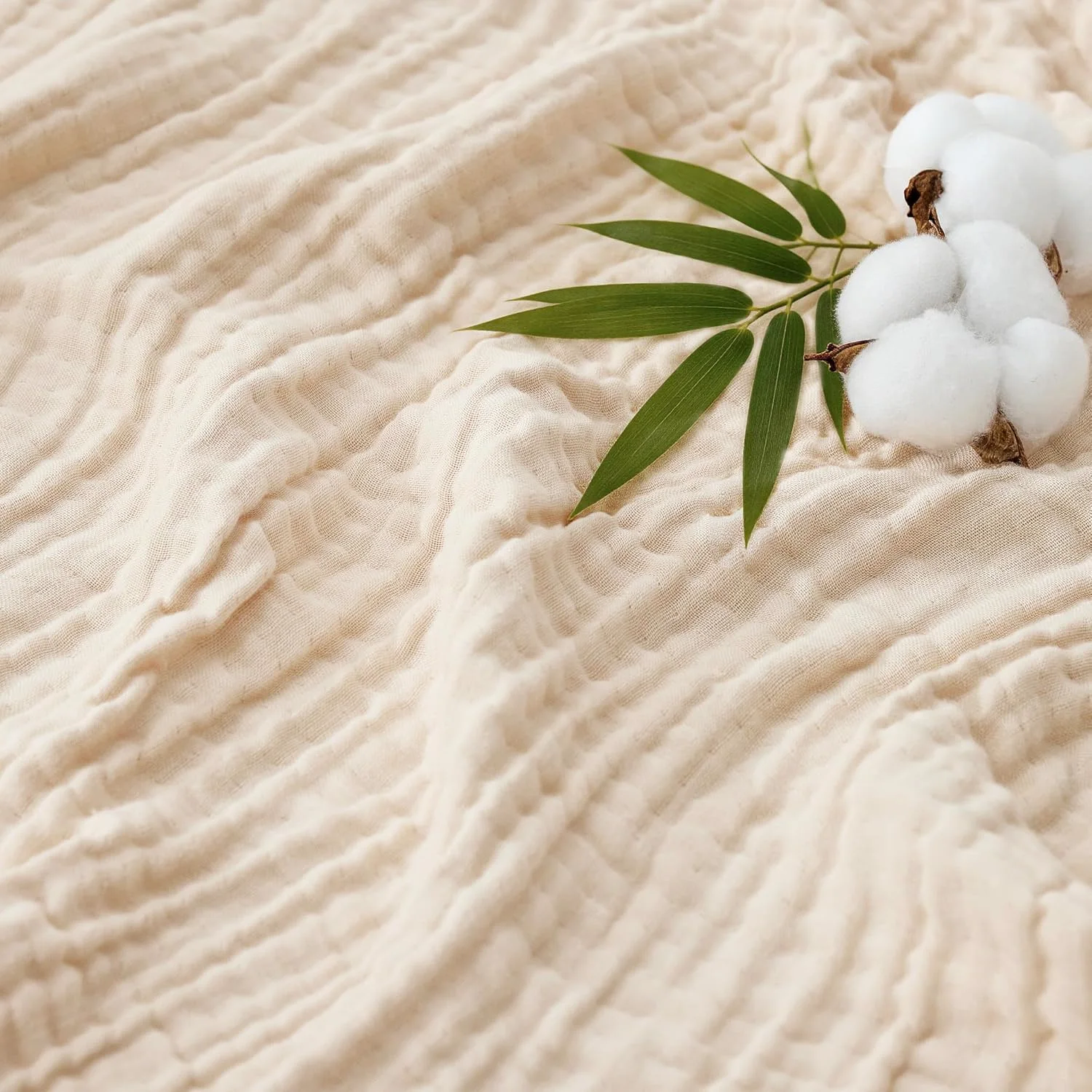
The washing machine is part of the product
Every fabric in this catalogue was chosen with a bias we admit openly: it has to survive, and preferably improve in, an ordinary home washing machine. No dry cleaning bills, no hand-wash-only labels hiding on the seam. That bias shapes what the wash routine looks like, and it is simpler than the internet makes it: cold water, gentle cycle, low heat drying, and a few fabric specific habits that do the real work.
The reward structure differs by fabric. Some, like muslin and prewashed cotton, genuinely get better with laundering. Some, like satin and cooling nylon, simply keep their qualities if washed right and lose them if cooked. And one category, the pet beds, just needs to be washable at all, completely and often. Here is the whole map.
Muslin and prewashed cotton: the fabrics that improve
Muslin arrives from the factory slightly stiff, its gauze layers pressed flat. The first wash blooms it: the layers relax, the surface puckers into the bubble texture the fabric is loved for, and each subsequent wash softens it further. This is not marketing; it is what loosely woven cotton does when fibres swell and relax through wet cycles. Our six layer cotton muslin and the four layer cooling blend both follow the same curve: adequate on day one, wonderful by wash five.
The routine that gets it there: machine wash cold, on gentle, with mild detergent and ideally on its own; the open weave likes room. Tumble dry low. Skip bleach forever and fabric softener mostly; softener coats the fibres and slows the very blooming you are waiting for. Expect a slight size settle after the first wash, which is normal for gauze.
The prewashed cotton quilt and prewashed comforter sets ship with the first washes already done, so they arrive already relaxed and crinkled. Their routine is the same, and their texture only deepens.
Satin and cooling nylon: keep the finish, skip the heat
Satin's virtues, the slip and the sheen, live in the surface of the weave, and the surface is what heat damages. The routine is therefore cold and quick: machine wash cold on gentle, tumble dry low, remove promptly. That is all. No bleach, which attacks the fibre; no high dryer settings, which dull the face of the fabric. Done this way, our pillowcases and satin sheet sets keep their glide for years, and they dry noticeably faster than cotton, a quiet bonus in a small apartment.
The Cooling Comforter follows the same law for a different reason: its cool-to-touch behaviour comes from the structure of very fine nylon fibres, and it is engineered to keep that behaviour through machine washing, on gentle and cold. If your skin is sensitive, wash any new bedding once before the first night; that is good practice for every fabric on this page.
Comforters, quilts and the vacuum pack revival
Down alternative comforters wash at home, which is half the reason to choose them over down. Cold water, gentle cycle, and the biggest drum you have access to; a comforter needs space to move or the detergent never rinses clean. Dry on low with a couple of dryer balls or clean tennis balls to break up the fill, and be patient: a comforter is dry when it is dry in the middle, not when the cover feels dry.
Two of our habits are worth stealing. First, the vacuum pack revival: every comforter set arrives compressed, and the fastest way to full loft is a first wash and a low tumble with dryer balls, which also removes packing folds. A few hours of airing does the same job more slowly. Second, the positioning lines and box stitching on our sets are not decoration; they keep the fill in place through exactly these wash cycles, and that makes an older set still looks evenly filled.
Quilts are easier: the ultrasonic pressed quilts have no stitching to snag and wash like large towels. Cold, gentle, low heat, done.
The pet corner: wash the whole bed, often
Pet bedding earns its keep in the wash more than anywhere else. Our donut beds and calming cat beds are built with no zippers precisely so the entire bed goes into the machine: gentle cycle, cold water, and then, and this matters for the faux fur, the dryer on low rather than air drying. Low heat tumbling keeps the shag from matting into felt; a line-dried fur bed comes back crunchy.
Cadence is a judgment call, but weekly for a bed a pet sleeps in nightly is not excessive, and it keeps the room honest too. The gear that does not fit a drum, the playpens and travel kennels, wipes down with warm water and mild soap, and their washable pads and mats go in with the towels.
One table to pin above the machine
| Fabric | Wash | Dry | Never |
|---|---|---|---|
| Cotton muslin | Cold, gentle, mild detergent | Tumble low | Bleach, softener overuse |
| Prewashed cotton | Cold, gentle | Tumble low | Hot dryer |
| Satin | Cold, gentle | Low, remove promptly | Bleach, high heat |
| Bamboo rayon | Cold below 104 F, gentle | Low, prompt removal | Hot water |
| Cooling nylon | Cold, gentle | Tumble low | Iron |
| Down alternative | Cold, big drum | Low with dryer balls | Overloading the drum |
| Polar fleece | Cold | Tumble low | Fabric softener |
| Pet beds, fur | Whole bed, gentle, cold | Dryer on low | Air drying the shag |
Every product page in the Love's Cabin catalogue repeats its own care line, and the muslin, comforter and pet shelves carry the fabrics this guide leans on hardest. When a page and this table ever disagree, trust the page; it is transcribed from the maker's label for that exact line.